Packaging measurements can seem confusing when one supplier uses millimetres while another lists inches. Product weight may also appear in grams or ounces. This guide explains the common measurements used for custom packaging in Australia. It includes useful conversion tables and practical steps to help you measure products with greater confidence.
Quick Answer: Packaging measurements are usually written as length × width × depth. Australian businesses commonly use millimetres for box dimensions and grams or kilograms for weight. One inch equals 25.4 millimetres while one ounce equals about 28.35 grams. Accurate measurements help create a box that fits the product and allows room for inserts or protective materials.
Understanding Packaging Measurements
Accurate measurements help a packaging supplier create a box that fits your product. They can also affect the amount of material required and the cost of production. A small measuring error may leave too much empty room or make the finished box difficult to close.
Most packaging dimensions are written in the following order:
Length × Width × Depth
You may also see the final measurement described as height. Both terms can be correct depending on the style and position of the box.
For example:
200 mm × 120 mm × 60 mm
This means the box is 200 mm long and 120 mm wide with a depth of 60 mm.
Why Correct Measurements Matter
A box should have enough room for the product without feeling loose. The right fit can improve presentation and help limit movement during handling. It can also reduce the need for unnecessary fillers.
Correct dimensions are particularly important when packaging:
- Glass jars and bottles
- Cosmetics and skincare products
- Soap bars
- Cakes and baked goods
- Clothing and fashion accessories
- Toys and collectable products
- Multiple products in one gift set
- Products that need a fitted insert
The product itself is not always the only item that must fit. Allow room for tissue paper or protective padding when required. Include instruction cards and inserts as well as any accessories that will be packed inside.
Metric and Imperial Measurements
Australia uses the metric system. Packaging dimensions are usually supplied in millimetres or centimetres. Weight is normally shown in grams or kilograms.
Some imported products and overseas packaging specifications use inches or ounces. Converting those measurements before requesting a quote helps prevent confusion.
| Measurement type |
Metric unit |
Imperial unit |
| Short length |
Millimetres |
Inches |
| Longer length |
Centimetres or metres |
Inches or feet |
| Product weight |
Grams or kilograms |
Ounces or pounds |
| Liquid volume |
Millilitres or litres |
Fluid ounces |
How to Measure a Box
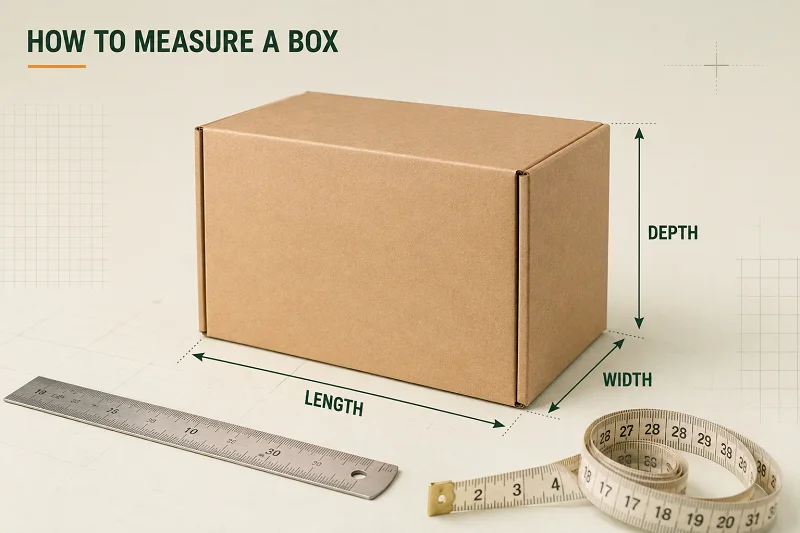
Use a firm ruler for small cartons. A tape measure can be more practical for shipping boxes and larger packaging. Place the empty box on a flat surface before measuring it.
1. Measure the Length
Length is normally the longest side of the box opening. Measure from one edge to the other without bending the ruler or tape.
2. Measure the Width
Width is the shorter side of the box opening. It runs at a right angle to the length.
3. Measure the Depth
Depth is the distance from the opening to the base. For an upright carton it may also be called height.
How to Measure a Product for Custom Packaging
Measure the product in the same position that it will have inside the finished box. A bottle that stands upright should be measured upright. A folded garment should be measured after it has been folded to its intended packing size.
Follow these steps:
- Place the product on a level surface.
- Measure its longest side.
- Measure the side running across it.
- Measure the full depth or height.
- Include any cap or handle that extends outward.
- Add the dimensions of protective wrapping if it will be used.
- Tell your supplier if you need a fitted insert.
Rounded and irregular products may need measurements from their widest points. It can also help to provide a photograph or physical sample when the shape is difficult to describe.
Internal and External Box Dimensions
Internal dimensions describe the usable space inside a box. External dimensions describe its total size from the outside.
The difference is created by the thickness of the packaging material. It may be small for a folding carton. It can be more noticeable with corrugated board or thick rigid board.
| Dimension type |
What it describes |
Why it matters |
| Internal dimensions |
Space available inside the box |
Helps confirm whether the product will fit |
| External dimensions |
Total outer size of the box |
Helps with storage and shipping calculations |
Expert Tip: Confirm whether the dimensions supplied by your packaging company refer to the usable internal space or the complete external size. Board thickness and folded panels affect the space inside the box. Measure your product at its widest and tallest points then include any caps or inserts and protective wrapping.
Ask whether a quoted size refers to internal or external dimensions before approving production. This is especially important for custom corrugated boxes because the fluted board adds thickness around the product.
Millimetres to Inches Conversion
Use the following formula to convert millimetres into inches:
Millimetres ÷ 25.4 = inches
To convert inches into millimetres use:
Inches × 25.4 = millimetres
| Millimetres |
Inches |
| 10 mm |
0.39 in |
| 25 mm |
0.98 in |
| 50 mm |
1.97 in |
| 75 mm |
2.95 in |
| 100 mm |
3.94 in |
| 150 mm |
5.91 in |
| 200 mm |
7.87 in |
| 250 mm |
9.84 in |
| 300 mm |
11.81 in |
Centimetres to Inches Conversion
One centimetre equals approximately 0.3937 inches. Use this formula:
Centimetres ÷ 2.54 = inches
| Centimetres |
Inches |
| 1 cm |
0.39 in |
| 5 cm |
1.97 in |
| 10 cm |
3.94 in |
| 15 cm |
5.91 in |
| 20 cm |
7.87 in |
| 25 cm |
9.84 in |
| 30 cm |
11.81 in |
How Many Grams Are in an Ounce?
One standard ounce equals approximately 28.35 grams. This is a measurement of weight rather than liquid volume.
Use the following formula:
Ounces × 28.3495 = grams
| Ounces |
Grams |
| 0.5 oz |
14.17 g |
| 1 oz |
28.35 g |
| 2 oz |
56.70 g |
| 3 oz |
85.05 g |
| 4 oz |
113.40 g |
| 5 oz |
141.75 g |
| 8 oz |
226.80 g |
| 10 oz |
283.50 g |
| 12 oz |
340.19 g |
| 16 oz |
453.59 g |
This conversion can be useful when an imported product displays its weight in ounces. Australian packaging will often show an equivalent metric quantity.
For products such as handmade bars you should measure the finished item as well as its weight. A supplier creating custom soap boxes needs the physical dimensions of the soap. Weight alone does not reveal whether the bar is long and narrow or short and thick.
Grams to Ounces Conversion
Use this formula to convert grams into ounces:
Grams ÷ 28.3495 = ounces
| Grams |
Ounces |
| 25 g |
0.88 oz |
| 50 g |
1.76 oz |
| 100 g |
3.53 oz |
| 125 g |
4.41 oz |
| 200 g |
7.05 oz |
| 250 g |
8.82 oz |
| 500 g |
17.64 oz |
| 750 g |
26.46 oz |
| 1,000 g |
35.27 oz |
Kilograms and Pounds Conversion
One kilogram equals approximately 2.2046 pounds. One pound equals approximately 453.59 grams.
| Kilograms |
Pounds |
| 0.5 kg |
1.10 lb |
| 1 kg |
2.20 lb |
| 2 kg |
4.41 lb |
| 5 kg |
11.02 lb |
| 10 kg |
22.05 lb |
| 20 kg |
44.09 lb |
These figures can help when reviewing imported product specifications. They may also assist with early freight planning. Your delivery provider may use its own rounding method or charging rules.
Weight Ounces and Fluid Ounces Are Different
An ounce measures weight. A fluid ounce measures liquid volume. They are not interchangeable.
A bottle marked 4 fl oz does not necessarily weigh 4 oz. Its final weight depends on the liquid and the bottle as well as the cap and other components.
| Unit |
Measures |
Common use |
| Ounce (oz) |
Weight |
Solid products and ingredients |
| Fluid ounce (fl oz) |
Liquid volume |
Drinks and liquid products |
| Gram (g) |
Weight |
Metric product quantities |
| Millilitre (mL) |
Liquid volume |
Metric liquid quantities |
This distinction matters for cosmetic packaging. A lotion bottle may contain 100 mL yet require a carton designed around the dimensions of the filled container. Businesses ordering custom cosmetic boxes should provide the bottle measurements and filled weight instead of relying only on the printed volume.
Net Weight and Gross Weight
Net weight is the weight of the product without its packaging. Gross weight includes the product and all packaging components.
For example a product may have:
- A net weight of 250 g
- A container weighing 40 g
- An outer carton weighing 25 g
- A total gross weight of 315 g
Gross weight is useful for estimating shipping loads. Net weight is more closely related to the quantity of product supplied to the customer.
Always check the current Australian labelling requirements that apply to your product. Food and regulated goods may have additional rules for measurement statements and label placement.
How to Calculate the Volume of a Box
Box volume describes the amount of three-dimensional space inside a box. Use the same unit for all three measurements before making the calculation.
Length × width × depth = volume
A box measuring 200 mm × 120 mm × 60 mm has the following volume:
200 × 120 × 60 = 1,440,000 mm³
Volume can help you compare box sizes. It does not confirm that every product will fit. Shape and orientation still matter. A long item may not fit inside a short square box even when the total volume appears sufficient.
What Is Volumetric Weight?
Volumetric weight is a shipping calculation based on the amount of space a parcel occupies. A large lightweight carton may be charged according to its volumetric weight rather than its actual weight.
Carriers use different formulas and conversion factors. A common calculation begins with:
Length × width × height ÷ carrier divisor
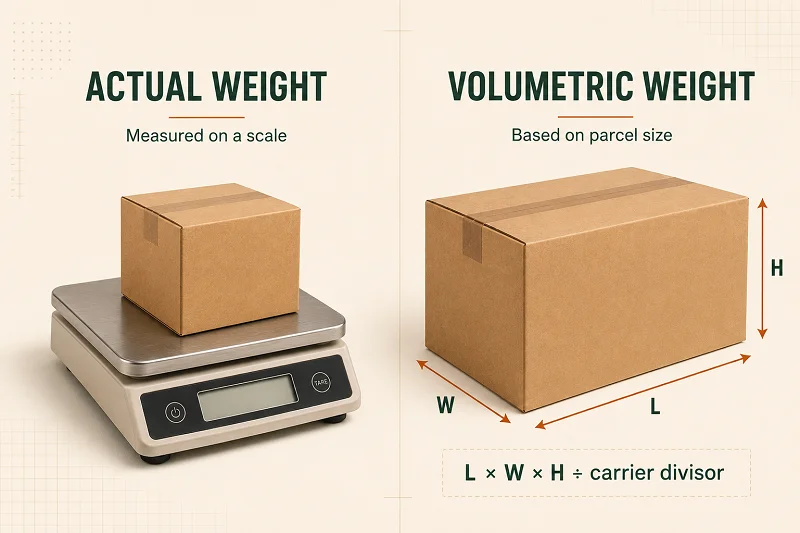
Check the formula used by your selected delivery provider before planning freight costs. Do not rely on a general online calculator when preparing a final shipping quote.
A well-fitted box can reduce unused space. It may also reduce the amount of filler required. Businesses that send products by courier may consider custom mailer boxes designed around the packed item.
How Packaging Material Affects Measurements
Material thickness changes the relationship between internal and external dimensions. The effect depends on the board and box structure.
| Packaging material |
Typical characteristic |
Measurement consideration |
| Paperboard |
Relatively thin and suitable for folding cartons |
Allows a compact retail box structure |
| Kraft board |
Natural appearance with several grades available |
Thickness should match the product weight |
| Corrugated board |
Contains a fluted inner layer |
Wall thickness affects the external box size |
| Rigid board |
Thick board used for premium boxes |
Requires careful allowance around products and inserts |
There is no single material that suits every product. A lightweight retail item may work well in paperboard. A heavier item that will travel through a delivery network may need a stronger structure. You can explore custom cardboard boxes when comparing flexible packaging options for different products.
Allowing Space for Inserts and Protective Materials
An insert holds the product in a planned position. It may be made from paperboard or corrugated board. Other materials may be considered when the product needs additional cushioning.
Tell your packaging supplier about every item that will sit inside the box. This may include:
- The main product
- Accessories or spare parts
- Instruction booklets
- Product cards
- Tissue paper
- Protective sleeves
- Samples or promotional items
Do not simply add a random amount to every side. Too much clearance can allow movement. Too little can place pressure on the product or stop the box from closing properly. The required allowance depends on the material and box style as well as the product.
Measuring Food and Bakery Products
Food packaging often needs extra attention because products may vary slightly in size. A cake can also include decorations that extend beyond its base.
When measuring a cake you should include:
- The cake board
- The tallest decoration
- Any topper that will remain attached
- Space needed to place and remove the cake safely
Businesses ordering custom cake boxes should include the cake board and tallest decoration when providing measurements. Confirm whether the chosen material is suitable for the intended type of food contact before placing an order.
Measuring Products Sold in Sets
Gift sets should be measured after the final product arrangement has been planned. Place every item in its intended position before recording the overall dimensions.
Think about the space between products and the thickness of any dividers. Taller items may need support to stop them leaning. Fragile items may need additional clearance around their edges.
A layout drawing can help the supplier understand how the set should look when opened. A physical sample is useful when the products have unusual shapes.
Common Packaging Measurement Mistakes
Mixing Millimetres and Centimetres
A measurement written as 25 may mean 25 mm or 25 cm. Always include the unit beside every dimension.
Changing the Dimension Order
Writing width first in one document and length first in another can cause errors. Use length × width × depth throughout your brief.
Measuring Only the Product Body
A bottle cap or jar lid may be wider than the main container. Measure the product at its widest and tallest points.
Forgetting the Packed Position
A product may have different measurements when standing and lying flat. Measure it in the position intended for the final packaging.
Ignoring Inserts and Accessories
An insert takes up room inside the box. Product cards and cables or spare parts can also change the required dimensions.
Rounding Too Early
Early rounding can make a converted size less accurate. Keep the full figure during calculation. Round only when you need to present the final measurement.
Using Weight to Estimate Physical Size
Two products can weigh the same and have very different shapes. Supply both the weight and dimensions when discussing custom packaging.
A clear brief can make the quotation process easier. Try to provide:
- Product length in millimetres
- Product width in millimetres
- Product depth or height in millimetres
- Filled product weight
- Required order quantity
- Preferred box style
- Material preference if known
- Printing requirements
- Any insert or divider requirements
- Photos or samples of unusual products
You do not need to select every technical detail before making an enquiry. Accurate product information gives the packaging team a stronger starting point.
Get the Measurements Right Before Production
Clear measurements help create packaging that looks considered and performs as intended. Record every dimension in the same unit. Confirm whether the figures are internal or external. Include the complete packed weight and allow for every item that will sit inside the box.
If you are unsure where to begin then send your product dimensions and packaging requirements to support@finepackaging.com.au. Fine Packaging can help you explore a suitable custom box structure. Request your free quote today and ask about free shipping for your custom packaging order.
Frequently Asked Questions
What order should box dimensions be written in?
Box dimensions are commonly written as length × width × depth. Some suppliers use height instead of depth. Confirm the order before approving a dieline or production size.
Should I measure a box internally or externally?
Use internal dimensions when checking the space available for a product. External dimensions are useful for storage and shipping. Tell the supplier which type of measurement you are providing.
How many grams are in one ounce?
One standard ounce equals approximately 28.35 grams. Multiply the number of ounces by 28.3495 when you need a more precise conversion.
Are ounces and fluid ounces the same?
No. An ounce tells you how heavy something is while a fluid ounce describes the amount of liquid it holds. To work out the gram weight of a fluid ounce you first need to know the liquid’s density.
How many millimetres are in one inch?
One inch equals exactly 25.4 millimetres. Multiply inches by 25.4 to convert a dimension into millimetres.
The required clearance depends on the product and packaging material as well as the box style. It also depends on whether an insert or protective wrapping will be used. Ask your supplier to recommend a suitable allowance rather than adding an arbitrary amount.
Does the weight of a product determine the box size?
No. Weight can influence material strength but it does not reveal the physical shape of a product. The supplier will normally need the length and width as well as the depth and packed weight.
Can Fine Packaging create a box around my product dimensions?
Yes. Fine Packaging can develop custom packaging around your supplied measurements and project requirements. Include raised caps or handles and any inserts when sending your product details.