Rigid boxes are known for their solid feel and polished appearance. They are commonly used for jewellery and cosmetics as well as candles and gift sets. Unlike folding cartons they are made from thick board that usually stays assembled. This guide explains what rigid boxes are and how they are constructed. It also covers materials and popular styles as well as practical uses.
Quick answer: A rigid box is a strong packaging format made from thick paperboard or greyboard. The structural board is normally covered with printed or decorative paper. It does not fold flat like an ordinary carton. Its firm walls and premium finish make it suitable for gifts and high-value retail products.
What Is a Rigid Box?
A rigid box is a pre-assembled box made with dense board. It is sometimes called a setup box because its main structure is formed during production and delivered ready to use. Most designs have firm walls that resist bending during normal handling.
The board creates the strength while an outer paper wrap provides the visible colour and branding. The inside may be lined with paper or fitted with an insert. Depending on the design it can also include magnets or ribbon pulls and other opening features.
Rigid boxes are thicker and less flexible than standard paperboard cartons. They also feel heavier in the hand. This gives them a substantial character that is often associated with premium products.
However a rigid box is not automatically suitable for every product. Its size and board thickness need to match the item being packed. The structure must also work with the way the product will be stored and displayed or delivered.
What Materials Are Rigid Boxes Made From?
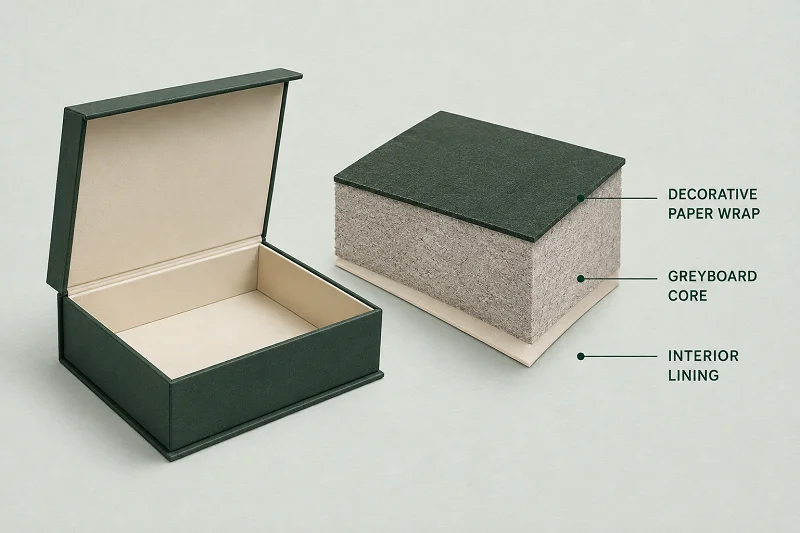
A finished rigid box may look like a single material. In practice it is usually made from several layers. Each layer has a particular job.
Rigid Board or Greyboard
The main structure is commonly made from greyboard. This is a dense paper-based board produced in a range of thicknesses. It forms the lid and base as well as the sides of the box.
Greyboard is generally hidden in the completed design. It sits beneath the outer wrap and interior lining. Its purpose is to provide shape and physical support rather than act as the printed surface.
The correct board thickness depends on the box dimensions and product weight. A compact jewellery box may not need the same specification as a large presentation kit. Using board that is too light can make a large box feel weak. Using unnecessarily thick board can add cost and weight without providing a useful benefit.
Outer Paper Wrap
The greyboard is normally covered with a thinner paper wrap. This layer provides the colour and texture that customers see and touch.
The wrap may be printed with brand artwork or supplied in a solid colour. It can also have a natural or textured surface. Matte and gloss lamination may be applied to printed paper before it is wrapped around the board.
A high-quality wrap should sit neatly across the main panels and corners. Poor alignment can make even a strong box look unfinished. Artwork should therefore account for folds and wrapped edges as well as visible panels.
Interior Lining
Interior paper can cover visible greyboard and create a cleaner presentation. It may match the exterior or use a contrasting colour. Some designs include printed messages or patterns inside the lid.
The lining material should suit the insert and product. Dark colours can produce a dramatic reveal while pale colours may create a softer appearance. The practical side matters too. A delicate product may need a lining that does not mark or rub against its surface.
Product Inserts
An insert sits inside the box and helps control the position of the product. Common options include folded paperboard and corrugated board as well as moulded pulp or foam. The suitable choice depends on the item and required presentation.
Paper-based inserts can be a practical option when recyclability and a consistent printed appearance are priorities. Foam can provide cushioning and a precise fit. However it may make material separation more difficult after use.
A well-designed insert should support the product without making it difficult to remove. Finger notches and ribbon lifts can improve access. Space may also be included for instructions or cables and accessories.
How Are Rigid Boxes Constructed?
Rigid box production involves more than cutting and folding one printed sheet. The structural board and decorative wrap are prepared separately before they are brought together.
1. The Box Dimensions Are Planned
The process begins with the product measurements and intended arrangement. The box maker considers the internal length and width as well as depth. Allowance may be required for an insert or protective wrap.
The opening style also affects the dimensions. A drawer must slide without becoming loose. A lid-and-base box needs enough clearance for the lid to fit over the base. Magnetic designs need space for the closing panels and concealed magnets.
2. The Structural Board Is Cut
Greyboard pieces are cut to the required shapes. The pieces may form separate panels or a connected structure depending on the box style.
Accurate cutting is important because small errors can affect the corners and lid fit. It can also change how the box sits when closed.
The board pieces are positioned and joined to form the main shell. Corners are secured so the structure keeps its shape. At this stage the box may look plain because the outer covering has not yet been applied.
4. The Wrap Is Printed and Finished
Artwork is printed onto the wrapping paper. Additional processes may include lamination or foil stamping and embossing. The finished sheet is then cut to suit the structure.
Artwork placement must account for the way the paper wraps over edges. A logo that looks centred on a flat proof may shift visually if these allowances are not planned correctly.
5. The Paper Is Wrapped Around the Board
Adhesive is applied and the printed sheet is positioned over the rigid structure. The paper is folded around the edges and turned into the inside where required.
Careful wrapping helps produce straight edges and tidy corners. It also keeps air pockets and wrinkles from appearing on broad surfaces.
6. Closures and Inserts Are Added
Magnets or ribbons and other components are installed where required. The interior lining and product insert are then fitted. The completed box is checked for alignment and surface quality as well as opening performance.
Expert tip: Test the box with the real product before approving a full production run. Include bottles with their caps and products in protective sleeves. Also include instruction cards and accessories. A precise sample can reveal movement or pressure points that may not be obvious from dimensions alone.
Rigid Boxes vs Folding Cartons
Rigid boxes and folding cartons are both paper-based packaging formats. They differ in construction and storage needs as well as cost and presentation.
| Feature |
Rigid Box |
Folding Carton |
| Main material |
Thick greyboard with a decorative wrap |
Printable paperboard or cardstock |
| Supplied form |
Usually supplied assembled |
Often supplied flat |
| Structural feel |
Firm and substantial |
Lightweight and foldable |
| Storage space |
Generally requires more room |
Requires less room before assembly |
| Relative cost |
Usually higher |
Usually lower |
| Common uses |
Gift sets and premium retail products |
Everyday retail and lightweight products |
A folding carton may be the more practical choice for a large everyday product range. It is efficient to store and can suit automated packing processes. A rigid box makes more sense when presentation and structural feel are important parts of the product experience.
Some brands use both formats. Standard products may be packed in folding cartons while limited editions and gift sets use rigid packaging.
Popular Types of Rigid Boxes
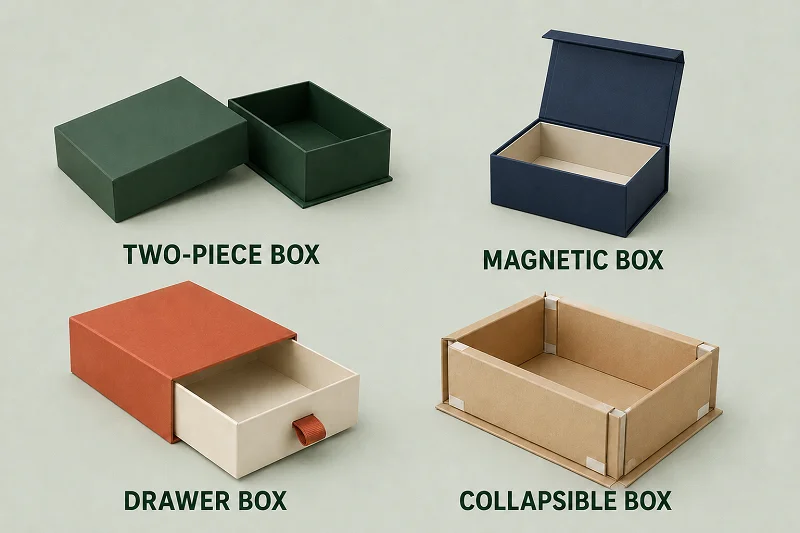
The term rigid box refers to the board construction rather than one particular opening style. Several structures are available.
Two-Piece Lid and Base Boxes
This classic format has a separate lid and base. The lid may cover the full depth of the base or only part of it. It suits gift sets and apparel as well as cosmetics and confectionery.
The simple opening creates a clear reveal when the lid is lifted. Different exterior and interior colours can be used to add contrast.
Magnetic Closure Boxes
A magnetic rigid box usually has a hinged lid with concealed magnets in the closing flap. The magnets help hold the lid in place and create a controlled opening action.
This structure is popular for corporate gifts and beauty sets as well as product launch kits. Magnets can complicate material separation at the end of the box’s life. Brands with environmental targets should consider this during specification.
Drawer Boxes
A drawer box contains an inner tray that slides from an outer sleeve. A ribbon pull or thumb opening can help the customer access the tray.
This structure provides a gradual product reveal. It can work well for jewellery and skincare products as well as smaller accessories. The tray needs enough clearance to move smoothly without feeling loose.
Shoulder and Neck Boxes
A shoulder and neck design usually has a base with a raised inner section. The lid meets the visible shoulder when the box is closed. The result is a layered appearance with clean separation between the main parts.
The exposed shoulder may use a contrasting colour or texture. This style is often selected for fragrance and jewellery or premium presentation products.
Book-Style Boxes
A book-style box has a hinged cover that opens from one side. The structure resembles a hardback book and provides a broad area for branding.
It can hold presentation kits or documents and collectable products. Closures may include magnets or ribbons depending on the design.
Collapsible Rigid Boxes
Collapsible rigid boxes are designed to fold down when not in use. Adhesive corners or locking panels are used to form the finished structure during packing.
They can reduce storage volume compared with traditional setup boxes. However they still need to be engineered carefully so the assembled box feels stable. They are useful for businesses that want a premium format but have limited warehouse space.
What Are Rigid Boxes Used For?
Rigid packaging is suitable for products where protection and presentation need to work together. Common applications include the following.
Jewellery and Watches
Small rigid boxes can create a secure setting for rings and earrings as well as necklaces and watches. A fitted insert limits movement and places the product in a clear viewing position.
The insert should suit the item rather than relying on a generic opening. Watch straps and necklace chains need different forms of support.
Cosmetics and Skincare
Beauty brands use rigid boxes for fragrance bottles and skincare sets as well as promotional collections. Multiple products can be arranged in a fitted tray to create a consistent presentation.
Bottles should be measured at their widest and tallest points. Pumps and droppers must be included. Fragile containers may require additional clearance and cushioning.
Candles and Home Fragrance
Rigid boxes can support the weight of candle jars and help present them as gifts. An insert can reduce side-to-side movement around the container.
The packaging should be tested with the actual candle. Glass weight and lid shape can change the required support. A rigid presentation box may still need an outer shipping carton for courier delivery.
Corporate Gifts and Presentation Kits
A larger rigid box can organise several products in one branded kit. It may hold notebooks and drinkware as well as cards or electronic accessories.
The arrangement should be planned before the box size is confirmed. Heavy objects need secure positions so they do not move into lighter items during transport.
Food and Confectionery Gifts
Rigid boxes are used for packaged chocolates and other gift foods. The correct lining or insert must be selected if food will touch the packaging directly.
Do not assume that every decorative paper or adhesive is suitable for direct food contact. Confirm the intended use and applicable material requirements with the packaging supplier.
Electronics and Accessories
Headphones and smart devices as well as cables and accessories can be arranged within a custom insert. The box can also provide space for setup instructions and warranty information.
Rigid packaging offers a strong presentation shell. It does not replace any specialist protection required for sensitive electronics.
Printing and Finishing Options
The outer wrap gives rigid packaging a wide range of branding possibilities. The best finish depends on the artwork and desired feel.
| Option |
Appearance |
Suitable Use |
| CMYK printing |
Supports detailed artwork and several colours |
Patterns and illustrations or photographic designs |
| PMS colour matching |
Targets a particular brand colour |
Colour-sensitive branding |
| Matte lamination |
Creates a restrained surface with reduced shine |
Minimal and understated packaging |
| Gloss lamination |
Produces a brighter reflective surface |
Bold colours and high-impact artwork |
| Soft-touch lamination |
Adds a smooth tactile finish |
Premium presentation boxes |
| Foil stamping |
Adds a metallic or coloured accent |
Logos and borders or selected details |
| Embossing |
Raises part of the surface |
Logos and simple graphic elements |
| Debossing |
Presses artwork into the surface |
Subtle tactile branding |
| Spot UV |
Adds shine to selected areas |
Contrast over a matte background |
Using several premium finishes at once does not always improve a design. One carefully placed foil logo may have greater impact than covering every panel with effects. Samples are useful when colour and texture are important to the final result.
Are Rigid Boxes Suitable for Shipping?
Rigid boxes provide good structural support but many are presentation packages rather than standalone shipping containers. A courier label placed directly on a finished box can damage the wrap. Corners and decorative surfaces may also be marked during handling.
For ecommerce delivery place the rigid box inside a suitable corrugated shipping carton or mailer. Use cushioning where required and prevent the presentation box from moving inside the outer package.
The shipping solution should be tested with the full packed weight. A sturdy presentation box cannot compensate for an outer carton that is too large or weak.
How to Measure for a Custom Rigid Box
Begin with the complete product rather than relying on a nominal product size. Measure the maximum length and width as well as height. Include caps and handles or other projecting parts.
If several items will share one box arrange them in their intended positions before measuring. Include any protective bags and instruction booklets or accessories.
Give measurements in the order requested by the supplier. Box dimensions are commonly stated as length × width × depth. Confirm whether the figures refer to internal or external dimensions. Internal measurements are generally more useful when checking product fit.
Do not add an arbitrary amount of empty space. The required allowance depends on the insert material and product tolerances as well as the opening structure. Your packaging supplier can calculate suitable clearance once the complete product details are available.
Advantages and Limitations of Rigid Packaging
Advantages
- Provides a strong and substantial presentation
- Holds its shape during normal storage and handling
- Supports detailed printing and premium finishes
- Can include fitted inserts for one or several products
- Offers several opening and reveal styles
- May be kept and reused by the customer
Limitations
- Usually costs more than a folding carton
- Traditional styles require more storage space
- Finished surfaces may need protection during shipping
- Mixed materials can make recycling more complicated
- Detailed structures may need longer production planning
- They can be unnecessarily heavy for some low-value products
The most suitable packaging is not always the most elaborate option. A rigid box should solve a genuine presentation or protection need. If a lightweight carton can perform the same job then it may provide better value and use fewer materials.
Are Rigid Boxes Recyclable?
The greyboard and paper wrap used in many rigid boxes are paper-based. Recycling suitability can still depend on the complete construction and local collection rules.
Magnets and foam inserts or plastic windows may need to be removed. Heavy coatings and fabric linings can also make separation more difficult. A design made from compatible paper-based components is generally easier to process than one containing several bonded materials.
Reusability is another consideration. A well-made rigid box may be kept for storage or gifting. However reuse should not be used to make broad environmental claims without supporting evidence.
Australian businesses should ask suppliers about recycled board content and material separation as well as the availability of paper-based inserts. Environmental wording should describe the actual packaging specification rather than relying on general terms such as eco-friendly.
How to Choose the Right Rigid Box
Start with the product and how it will reach the customer. Consider its weight and fragility as well as retail value. Then choose a structure that supports the intended opening experience.
A two-piece box offers a familiar gift presentation. A drawer creates a slower reveal. A magnetic box provides an attached lid and distinct closing action. A collapsible design may suit a business that needs to reduce storage space.
Next choose the board specification and insert. These structural choices should come before decorative finishes. Once the fit works well you can develop the printed wrap and select any foil or embossing and lamination.
A useful production brief should include:
- Internal box dimensions or complete product measurements
- Product weight and number of items per box
- Preferred opening style
- Insert and product layout requirements
- Order quantity and possible repeat volumes
- Brand colours and artwork files
- Preferred printing and finishing options
- Required delivery date and Australian postcode
- Whether an outer shipping carton is needed
A Strong Box Should Have a Clear Purpose
Rigid boxes combine dense structural board with a decorative outer wrap. Their solid construction and broad customisation options make them suitable for products that need a more substantial presentation. They can hold jewellery and beauty products as well as candles and gift sets or electronics.
The best result begins with accurate measurements and a suitable structure. Board thickness and insert design should support the real product. Printing and finishing can then build the desired brand character without interfering with practical use.
When chosen carefully a rigid box does more than look impressive. It organises the contents and controls the product reveal while giving the customer packaging that feels considered from the first touch.
Frequently Asked Questions
What makes a box a rigid box?
A rigid box is made from thick board that holds its shape. It does not need to be folded before use. Printed or decorative paper is usually wrapped around the board to create the finished look.
What type of board is used for rigid boxes?
Most rigid boxes are made with dense greyboard. This board forms the strong inner structure. The right thickness depends on the box size and the weight of the product.
Do rigid boxes arrive flat or assembled?
Traditional rigid boxes usually arrive fully assembled. They need more storage space than folding cartons. Collapsible rigid boxes can be stored flat and put together when needed.
Can rigid boxes include fitted inserts?
Yes. A fitted insert can hold one product or several items in place. Inserts may be made from paperboard or corrugated board as well as moulded pulp or foam.
Can I use a rigid box for shipping?
A rigid box can support the product but its finished surface may be damaged during delivery. It is best to place it inside a corrugated shipping box or mailer. Add padding if needed to stop it from moving.
Are rigid boxes recyclable in Australia?
Many rigid boxes are made from paper-based materials. Magnets and foam or plastic parts may need to be removed before recycling. Check the rules from your local council before placing the box in a recycling bin.
How should I measure a product for a rigid box?
Measure the full length and width as well as height of the product. Include caps and handles or protective sleeves. You should also include any accessories and allow space for an insert if one is needed.


