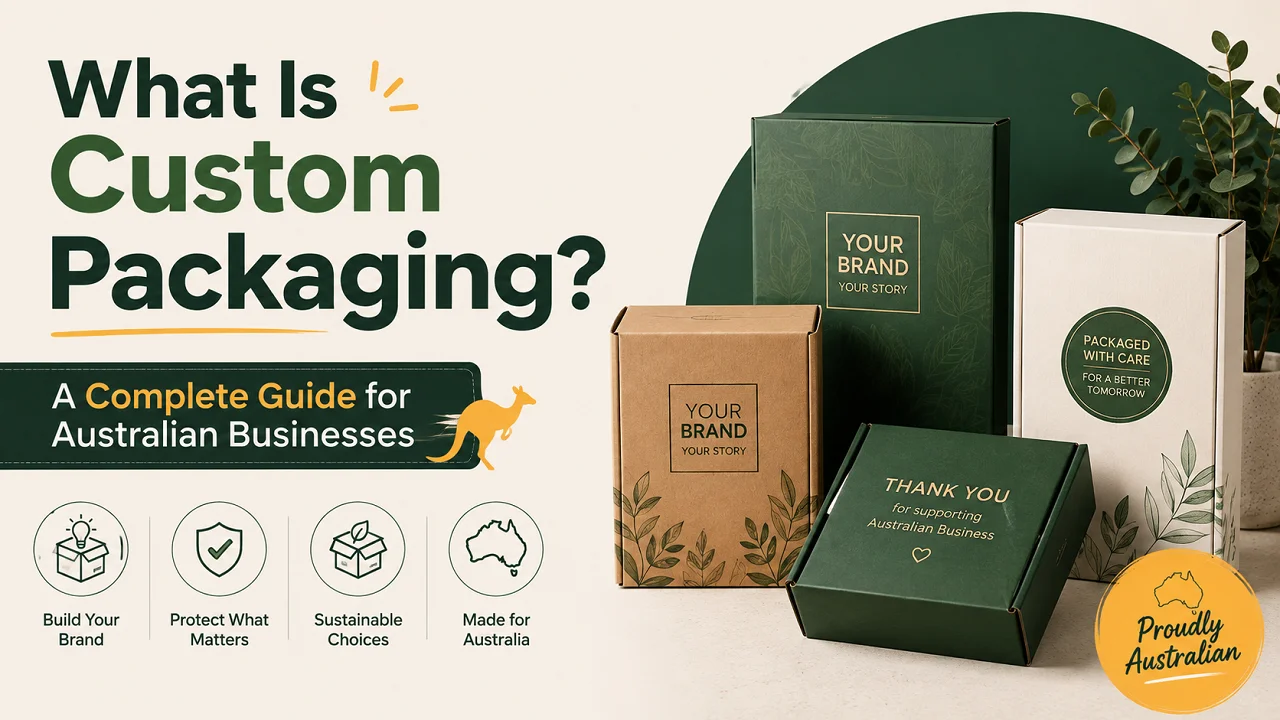
What Is Custom Packaging? A Complete Guide for Australian Businesses
Custom packaging is packaging made to suit a particular product and brand rather than relying on a standard ready-made box. Businesses can choose the size, material, box style, printing and finishing details to create packaging that works around their products. From small online stores to established Australian retailers, custom packaging can improve presentation while giving products the support they need during storage, display and delivery.
Quick Answer: Custom packaging is packaging designed around a specific product and brand. Businesses can customise the size material box style printing colours and finishes. It can provide a better product fit while helping Australian businesses create packaging that reflects their brand across retail and ecommerce.
What Does Custom Packaging Mean?
Custom packaging refers to boxes, bags, pouches, cartons and other packaging that has been designed around the needs of a specific product or business.
Instead of choosing a plain box from a limited range of standard sizes, a business can decide how its packaging should look and function. This can include the dimensions, material, structure, artwork, colours and finishing options.
For example, a skincare company may need a small printed carton that fits closely around a serum bottle. An ecommerce business might prefer a corrugated mailer box with its logo printed on the outside. A premium gift brand could use a rigid box with foil stamping and a custom insert.
All three are examples of custom packaging even though the boxes look and perform very differently.
The main idea is simple. The packaging is created around the product and the brand rather than making the product fit into whatever packaging happens to be available.
How Does Custom Packaging Work?
Creating custom packaging normally starts with understanding the product.
The packaging supplier needs to know what is being packed, how large it is, how heavy it is and how the finished product will be stored or delivered. These details help determine the most suitable material and box structure.
A typical custom packaging project can involve the following stages:
- Choose the type of packaging required.
- Measure the product and determine the box dimensions.
- Select a suitable packaging material.
- Choose the box style or structural design.
- Create a dieline for the artwork.
- Add branding, colours and product information.
- Select printing and finishing options.
- Review a digital proof or physical sample where required.
- Approve the design for production.
- Manufacture and deliver the finished packaging.
The exact process can vary depending on the packaging style and order size. A simple cardboard carton may be straightforward to manufacture while a luxury rigid box with inserts and special finishes can require additional production stages.
Custom Packaging vs Standard Packaging
Standard packaging is manufactured in predetermined dimensions and designs. It is usually available quickly and can be useful when appearance and exact product fit are not major concerns.
Custom packaging takes a different approach. It gives the business control over how the package fits, looks and performs.
| Feature |
Custom Packaging |
Standard Packaging |
| Size |
Made around specific product dimensions |
Available in predetermined sizes |
| Branding |
Can include logos, colours and custom artwork |
Often plain or limited |
| Materials |
Selected according to the product |
Limited to available stock |
| Printing |
Wide range of printing options |
Usually plain or basic |
| Finishes |
Matte, gloss, foil, Spot UV and more |
Generally limited |
| Product Fit |
Can be made for a close and secure fit |
May leave unused space |
| Best Suited To |
Retail, ecommerce, gifting and branded products |
General packing, storage and basic shipping |
The better option depends on the business and what the packaging needs to do. Standard boxes can make sense for basic storage or occasional shipping. Custom packaging becomes more useful when product fit, branding or customer presentation matters.
Why Do Businesses Use Custom Packaging?
Packaging has several jobs to do before a customer even opens it.
It needs to hold the product properly. It may need to handle stacking, transport or retail display. It also needs to give customers the right impression of the brand.
Custom packaging boxes can bring these practical and branding needs together.
Better Product Fit
A box made around the dimensions of a product can reduce unnecessary movement inside the package. It can also reduce the need for excessive filler material.
This is particularly useful for glass products, cosmetics, electronics and other items that need to stay in place during transport.
Stronger Brand Presentation
A plain carton performs a practical job. A branded carton can do the same job while also helping customers recognise the business.
Logos, colours, typography and artwork can all be incorporated into custom printed packaging. This gives businesses a consistent look across retail shelves, online orders and promotional products.
A More Considered Customer Experience
Customers often interact with the packaging before they interact with the product itself.
A neatly fitted box that opens well and presents the product clearly can make the purchase feel more considered. This can be particularly important for gifts, beauty products, fashion accessories and products purchased online.
More Control Over Packaging
Customisation gives businesses more control over details that standard packaging cannot always provide.
You can select how the box opens, where information appears, whether the product can be seen through a window and how individual components sit inside the pack.
What Types of Custom Packaging Are Available?
Custom packaging covers far more than printed cardboard boxes. The right option depends on what you sell and how the product reaches your customer.
Common types include:
A business may also use more than one type of packaging for the same product.
For example, a glass skincare bottle could sit inside a printed folding carton. Several of those cartons could then be packed inside a corrugated shipping box for transport to a retailer.
Each layer has a different purpose.
Common Materials Used for Custom Packaging
The material is one of the most important decisions in any packaging project. It affects strength, appearance, printing and cost.
| Material |
Common Uses |
Key Characteristics |
| Cardboard / Paperboard |
Cosmetics, food, supplements, small retail products |
Lightweight with a smooth printing surface |
| Kraft Paperboard |
Natural products, handmade goods, retail packaging |
Natural appearance with a simple earthy finish |
| Corrugated Board |
Ecommerce, shipping and heavier products |
Fluted construction provides extra strength |
| Rigid Board |
Premium gifts, jewellery, luxury products |
Thick construction with a substantial presentation |
Cardboard and Paperboard
Paperboard is widely used for everyday retail packaging because it is lightweight and easy to print.
It suits products such as skincare, soaps, candles, electronics accessories, toys and pharmaceuticals. It can be folded into many carton structures while providing plenty of space for artwork and product information.
Kraft Board
Kraft packaging has a natural brown appearance although other finishes may also be available.
It works particularly well for brands that prefer a simple or organic presentation. Kraft board can be printed with logos, text and artwork while keeping its recognisable natural look.
Corrugated Board
Corrugated board includes a fluted layer between liner sheets. This construction gives it more strength than standard folding paperboard.
It is commonly used for ecommerce mailers, delivery cartons, heavier products and wholesale shipping.
Rigid Board
Rigid packaging boxes are manufactured from thick board that does not fold flat in the same way as standard cartons.
They are generally selected when presentation is a priority. Jewellery, cosmetics collections, corporate gifts and premium products are common examples.
Popular Custom Packaging Box Styles
Once the material has been selected the next decision is often the structure of the box.
The way a box is built affects how it opens how much support it provides and how the product looks inside.
Tuck End Boxes
Tuck end cartons are widely used for small retail products. Common variations include straight tuck end and reverse tuck end boxes.
They work well for cosmetics, supplements, electronics accessories, skincare and many lightweight products.
Auto Lock Bottom Boxes
An auto lock base folds into position and creates a stronger bottom than many simple tuck cartons.
This style can be useful when the contents carry more weight or when businesses want faster packing during fulfilment.
Mailer Boxes
Mailer boxes are especially popular with ecommerce brands. They provide a neat opening experience and can be printed on the inside as well as the outside.
Corrugated mailers are often used for subscription products, fashion accessories, gifts and products sold directly online.
Two Piece Boxes
A two piece box has a separate lid and base. The style can be made using folding board or rigid material depending on the required presentation.
It is commonly seen across gifts, clothing, cosmetics and premium retail products.
Sleeve Packaging
A printed sleeve can slide over a tray, carton or product.
Sleeves are useful when a business wants to add branding without creating an entirely enclosed package. They can also help create different product variations while using the same inner packaging.
Window Boxes
Window packaging allows part of the product to remain visible.
It is often used for bakery products, toys, cosmetics, candles and retail items where customers may want to see the product before buying.
What Can Be Customised?
The word “custom” does not only refer to printing a logo on a standard box.
Depending on the packaging type, businesses can customise almost every major part of the package.
- Length, width and depth
- Box structure
- Material
- Board thickness
- Printing method
- Brand colours
- Logo placement
- Product artwork
- Interior printing
- Window shape
- Inserts
- Surface coating
- Foil details
- Embossed or debossed elements
- Opening experience
Not every package needs every option. Good custom packaging uses the features that make sense for the product instead of adding decoration simply because it is available.
Printing Methods Used for Custom Packaging
Printing turns a structural package into branded packaging. The best method can depend on the material, artwork, quantity and level of detail required.
| Printing Method |
Best Suited To |
| Digital Printing |
Shorter runs, detailed artwork and product launches |
| Offset Printing |
Larger runs requiring sharp and consistent print |
| Flexographic Printing |
Corrugated packaging and larger production volumes |
| CMYK Printing |
Full colour artwork and product images |
| PMS Printing |
Brands that require accurate spot colour matching |
Digital Printing
Digital printing can be a practical choice for smaller production runs and changing artwork. It works well for detailed graphics and does not require the same plate setup used by some traditional printing methods.
Offset Printing
Offset printing provides sharp details and strong colour consistency. It is commonly considered for larger production quantities and premium retail packaging.
Flexographic Printing
Flexographic printing is widely associated with corrugated packaging. It works well for logos, handling information and straightforward graphics on shipping cartons.
Finishing Options for Custom Packaging
Finishes change the surface appearance or texture of a package. They can be used across the whole box or only in selected areas.
| Finishing Option |
Description |
| Matte Lamination |
Matte lamination creates a smooth finish with reduced shine. It is widely used for clean and contemporary packaging designs. |
| Gloss Lamination |
Gloss lamination creates a shinier surface and can make printed colours appear brighter. |
| Soft Touch Coating |
Soft touch creates a smooth tactile feel. It is often chosen for premium cosmetics, gifts and high-end retail packaging. |
| Spot UV |
Spot UV places a glossy coating over selected design areas. A logo or product name can be highlighted while the rest of the packaging remains matte. |
| Foil Stamping |
Foil stamping can add metallic details to logos, text or decorative artwork. Gold and silver are common choices although other foil colours may also be available. |
| Embossing and Debossing |
Embossing raises selected artwork from the surface while debossing presses the design into the material. Both techniques add texture without relying only on printed colour. |
Why Are Custom Inserts Used?
Some products need more than an outer box.
A custom insert sits inside the packaging and helps organise or hold the contents in position.
Inserts are particularly useful for products such as:
- Glass bottles
- Cosmetic jars
- Electronics
- Jewellery
- Gift sets
- Candles
- Multiple product kits
The insert can be designed around the shape and dimensions of individual items.
Paperboard, corrugated board and moulded fibre are some of the options that may be considered depending on the product and packaging design.
Custom Packaging for Different Industries
The best packaging for a product often depends on where the product is sold and what customers expect from that industry.
Cosmetics and Skincare
Cosmetic packaging often uses folding cartons with detailed printing and premium finishes. Inserts may be added for glass bottles, jars or product sets.
Food and Beverage
Food packaging can include bakery boxes, takeaway cartons, product sleeves, display packaging and retail cartons.
The materials and coatings need to suit the particular food application and any relevant packaging requirements.
Ecommerce
Ecommerce packaging needs to handle the journey between the business and the customer.
Corrugated mailer boxes and shipping cartons are common choices because they combine structural support with space for branding.
Electronics
Electronic products may need packaging that keeps the device and accessories organised. Inserts can create separate spaces for cables, chargers and other components.
Fashion and Accessories
Clothing, jewellery and fashion accessories often use packaging as part of the overall presentation.
Mailer boxes, folding cartons and rigid gift boxes can all be used depending on the product value and sales channel.
Retail Products
Retail packaging needs to communicate quickly.
Customers may see several similar products beside each other on a shelf. Clear branding, product information and a practical box structure can make it easier for the product to be identified.
Custom Packaging for Small Businesses
Custom packaging is not only for large retailers.
Australian startups and small businesses can use branded packaging to create a more established presentation without making the packaging overly complicated.
A small business might begin with a straightforward printed cardboard box using one or two brand colours. As sales grow, additional finishes or specialised structures can be introduced.
Choosing a sensible minimum order quantity is important when starting out. Buying far more packaging than required can tie up storage space and cash. Ordering too little can also become inconvenient if the product sells faster than expected.
The best starting point is usually packaging that performs its main job well and gives the brand enough room to look professional.
Is Custom Packaging Eco Friendly?
Custom packaging can be designed with sustainability in mind although the word “custom” does not automatically make packaging environmentally friendly.
The result depends on the material, coatings, construction and how efficiently the package has been designed.
Businesses looking for a more considered approach can explore options such as:
- Recyclable paperboard
- Kraft materials
- Corrugated board
- Recycled content where suitable
- Right-sized packaging
- Paper-based inserts
- Reduced unnecessary material
- Simpler print coverage
Right-sizing is particularly useful. A box that closely matches the product can reduce empty space and may lower the amount of filler required.
It is also worth looking at the complete packaging system rather than focusing on one environmental claim. Materials, finishes, transport and end-of-life options all play a part.
How Much Does Custom Packaging Cost?
There is no single price for custom packaging because every project can have different specifications.
Cost can be affected by:
- Box dimensions
- Packaging material
- Board thickness
- Order quantity
- Printing method
- Number of printed colours
- Special finishes
- Custom inserts
- Complex structural designs
- Production requirements
A simple printed folding carton will usually have a very different production cost from a rigid presentation box with a magnetic closure and custom insert.
Order volume can also affect the cost per unit. Larger production runs may spread setup costs across more pieces.
For that reason, businesses should compare packaging based on the complete specification rather than simply asking for the cheapest box.
What Is a Minimum Order Quantity?
A minimum order quantity or MOQ is the smallest production quantity a packaging supplier is willing to manufacture for a particular order.
Custom packaging generally has an MOQ because machinery, cutting dies, printing and production setup all require preparation before manufacturing begins.
MOQs can vary between packaging suppliers and can also depend on the box style or material being used.
Small businesses should check the MOQ before investing heavily in packaging artwork. This makes it easier to choose an option that suits both the product and the current sales volume.
How Long Does Custom Packaging Take?
Custom packaging takes longer than purchasing an off-the-shelf carton because the packaging needs to be prepared specifically for the order.
The process may involve structural design, artwork preparation, proofing, printing, cutting, finishing and assembly.
Production time can vary depending on the complexity of the box and the order quantity.
Businesses launching a new product should allow room in their schedule for artwork adjustments and approval. Rushing the design stage can lead to simple mistakes that become expensive once the full order has been produced.
How Do You Choose the Right Custom Packaging?
Good packaging starts with practical questions rather than decorative finishes.
Expert Tip: Measure your product before settling on a box style. Check the length width and depth along with the weight and any fragile areas. These details make it easier to choose the right board and avoid paying for a box that is larger or heavier than your product actually needs.
Start With the Product
Measure the product accurately and consider its weight, shape and fragility.
A lightweight lip balm needs a different packaging structure from a ceramic candle or electronic device.
Think About the Sales Channel
A product sitting on a retail shelf has different needs from something travelling through an ecommerce delivery network.
Retail packaging may focus more heavily on shelf presentation while delivery packaging needs to account for handling and transport.
Set a Realistic Budget
Packaging should support the product rather than consume an unreasonable share of its margin.
Premium finishes can look impressive but they should have a clear purpose within the overall design.
Keep the Design Clear
More artwork does not always create better packaging.
A strong logo, clear product name and organised information can often communicate more effectively than filling every panel with design elements.
Plan for Future Orders
Consider how easily the packaging can be reordered or adapted if the business adds new flavours, colours, sizes or product variations.
A flexible packaging system can save time as a range expands.
Common Custom Packaging Mistakes
Custom packaging gives businesses plenty of freedom. That freedom also creates room for avoidable mistakes.
Choosing a Box Before Measuring the Product
The dimensions should come first. Even a small measurement error can affect how well the product sits inside the package.
Using More Packaging Than Necessary
An oversized box may require extra filler and can make a small product feel lost inside the pack.
Right-sized packaging usually creates a neater result.
Adding Too Many Design Features
Foil, UV coating, embossing, windows and complex artwork can all look good when used well. Putting everything onto one package can quickly make the design feel busy.
Branding is important but packaging may also need space for ingredients, warnings, instructions, barcodes, product details or other required information.
These elements should be considered during the artwork stage rather than added at the last minute.
Ignoring Shipping Conditions
Retail presentation is only part of the journey.
If the finished package is being sent through warehouses or courier networks, the outer packaging also needs to cope with those conditions.
Custom Packaging in Australia
Australian businesses use custom packaging across retail, ecommerce, hospitality, beauty, food, electronics and many other industries.
Packaging needs can change quite a bit from one business to the next. A Melbourne skincare startup selling directly online can have completely different packaging needs from a Sydney retailer distributing products to stores across the country.
Distance is another practical consideration in Australia. Products may travel between metro areas, regional centres and remote locations before reaching the final customer.
This makes it worth thinking about the full packaging journey. A good-looking retail box is useful but the product still needs to arrive in suitable condition.
Businesses should consider both primary product packaging and any outer cartons needed for storage or transport.
Does Custom Packaging Help With Branding?
Packaging can become one of the most visible parts of a brand.
Customers may see a box in a shop, receive it through the post or watch someone open it online. Consistent packaging helps connect these experiences back to the same business.
Useful branding elements can include:
- A recognisable logo
- Consistent brand colours
- Clear typography
- A simple visual style
- Product information
- Website or social details
- Short brand messages
The aim is not to cover every available surface. Strong packaging usually makes it easy to understand who made the product and what is inside.
Is Custom Packaging Worth It?
Custom packaging can be worthwhile when it solves a genuine business need.
That need might be better product fit, stronger retail presentation, more organised shipping or a consistent brand identity.
It becomes less useful when custom features are added without considering whether they improve the package.
A business selling inexpensive everyday products may not need elaborate rigid boxes. A premium gift collection might benefit from a stronger presentation because the packaging forms part of the buying experience.
The right level of customisation depends on the product, customer and budget.
Getting Started With Custom Packaging
If you are planning custom packaging for a new or existing product, start with the basics.
Know the product dimensions. Decide where the product will be sold and how it will be transported. Think about the amount of branding required and set a realistic order quantity.
From there you can compare materials, box styles, printing methods and finishes without making the process more complicated than it needs to be.
Fine Packaging works with Australian businesses looking for custom packaging across retail, ecommerce, cosmetics, food, gifts and a wide range of other products. Packaging can be created in custom sizes with different materials, printing methods, box structures and finishing options to suit your brand.
If you are not sure which packaging option will work for your product, send through your dimensions and requirements. We can talk through the choices with you and find an option that suits your product. Request a free quote today and start planning packaging built around your product, your customers and the way your business sells.
Frequently Asked Questions About Custom Packaging
What is custom packaging?
Custom packaging is made to suit a particular product and brand. You can choose the size material box style printing and finishes instead of relying on a standard ready made package.
What can I customise on packaging?
You can customise the dimensions material colours artwork logo placement and box style. Depending on the packaging type you can also add windows inserts foil stamping embossing and other finishing options.
Is custom packaging suitable for small businesses?
Yes. Custom packaging can work well for Australian startups and small businesses. A simple branded carton or mailer box can create a professional look without needing an overly complicated design.
What materials are used for custom packaging?
Common options include cardboard kraft paperboard corrugated board and rigid board. The right material depends on the product weight required strength presentation and how the package will be stored or delivered.
How do I choose the right custom packaging?
Start with your product size weight and shape. Then think about where it will be sold and how it will reach the customer. These details make it easier to choose a suitable material box style and level of protection.
Is custom packaging better than standard packaging?
It depends on what you need. Standard packaging can be handy for basic storage and shipping. Custom packaging is usually a better fit when you want specific dimensions branded printing or a more considered product presentation.