Cardboard Packaging Made to Present Every Chocolate with Care
Branded chocolate boxes have two important jobs. They should support the product during handling and create a strong first impression before the box is opened. Our custom cardboard chocolate boxes can be developed around the shape and arrangement of your products. This gives you control over the fit instead of making your chocolates work with a standard box.
We can produce packaging for independent chocolatiers and established confectionery businesses as well as gift suppliers and event companies. Every project can be adjusted through its size and structure plus its board and artwork. You can keep the result simple for an everyday range or add selected details for a seasonal or luxury collection.
Custom cardboard chocolate boxes also provide useful space for your logo and flavour details as well as ingredients and allergen statements. A well-planned layout helps customers understand the product while keeping the design clear. Our team can prepare a dieline based on your chosen dimensions so your designer can position each element on the correct panel.
What Are Custom Cardboard Chocolate Boxes?
Custom cardboard chocolate boxes are made-to-order paper-based cartons designed to contain wrapped chocolates or chocolates placed in an appropriate food-safe tray or insert. They can be cut to a required length and width as well as depth. Their structure may suit one chocolate bar or a collection of individual pieces.
A cardboard chocolate box is not the same as the primary wrapper used around a chocolate bar. Standard printed board may not provide the moisture or grease barrier required for direct food contact. Chocolates should remain wrapped unless the selected board and every internal component have been confirmed as suitable for direct contact with food.
Personalised cardboard chocolate boxes may be supplied flat where the structure permits it. Flat delivery can reduce storage space before packing. Rigid styles and some assembled formats take up more room but can provide a more substantial presentation. The best option depends on your packing process and product weight as well as the experience you want to create.
Cardboard Boxes for Different Chocolate Products
Chocolate products vary greatly in size and fragility. The packaging for a slim wrapped bar will not have the same requirements as a box of hand-finished truffles. We review the product format before recommending the board and construction. This helps create custom cardboard chocolate boxes that look considered and remain practical to pack.
Chocolate Bars and Slim Confectionery
Folding cartons and printed sleeves work well for individually wrapped bars. A tuck-end carton can enclose the whole product while a sleeve leaves selected parts of the inner wrapper visible. Both formats offer panels for flavour names and cocoa information or brand artwork. Custom cardboard chocolate boxes can also be made for sets of bars in different flavours.
Truffles and Pralines
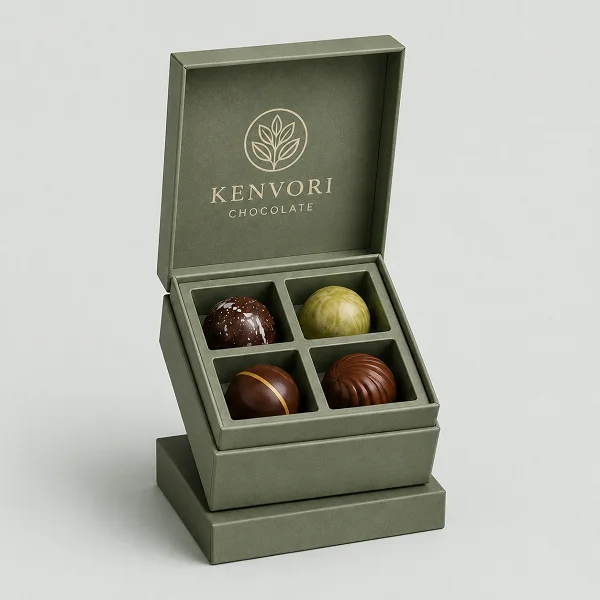
Individual chocolates often require compartments that limit contact between pieces. A paperboard insert may be cut with cells for each chocolate. Food-safe cups can also be used where appropriate. The box depth should provide enough clearance above decorations without allowing excessive vertical movement. These details are important when preparing elegant chocolate gift boxes.
Small Chocolate Portions and Favours
Small cardboard boxes for chocolates can hold one or two pieces for weddings and product samples or promotional campaigns. Pillow boxes and miniature tuck cartons as well as small two-piece boxes are possible options. The structure should be tested at its final size because very small folds and panels may need artwork adjustments.
Assorted and Seasonal Collections
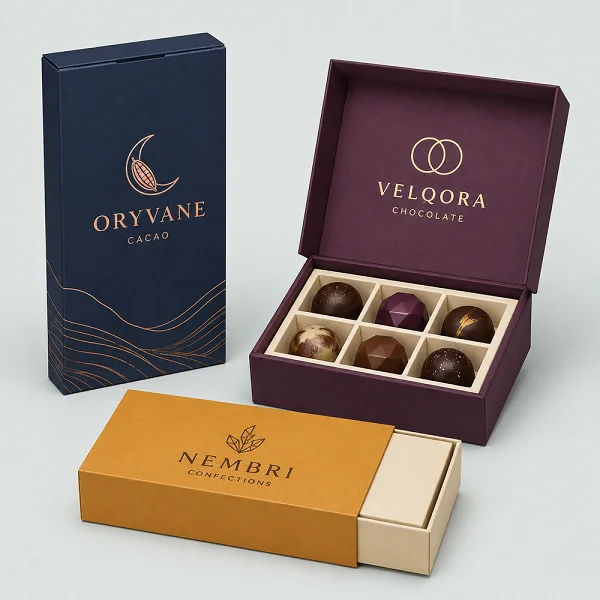
Assorted collections may need a wider tray with several compartments. The printed design can identify flavours through a guide inside the lid or on the base. Seasonal packaging can change the artwork while retaining an established structure. This can make repeat ordering more efficient when the chocolates and internal arrangement remain the same.
Choose a Structure That Supports Your Presentation
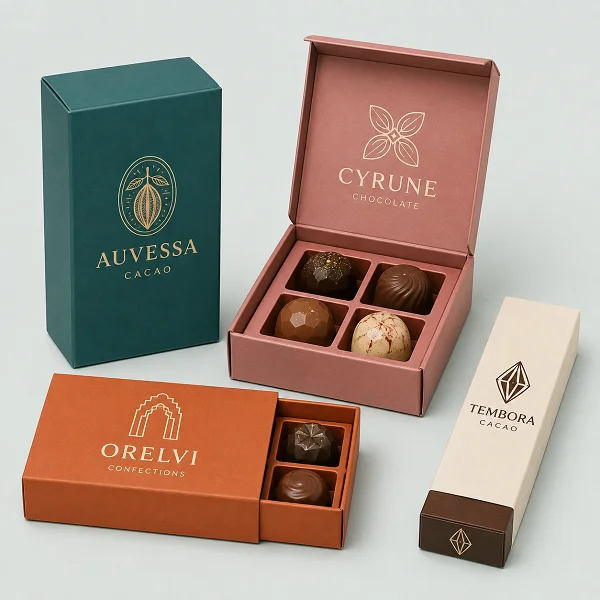
The structure affects how customers open the packaging and how efficiently your team can assemble it. Our custom cardboard chocolate boxes can be developed in several formats. The ideal construction will depend on the product layout and packed weight plus your budget and fulfilment method.
Tuck-End Chocolate Boxes
Straight tuck-end and reverse tuck-end cartons are practical choices for chocolate bars and compact confectionery products. They arrive flat and are usually quick to assemble. Their broad front and back panels provide useful room for printed chocolate boxes with detailed brand artwork.
Tray and Sleeve Boxes
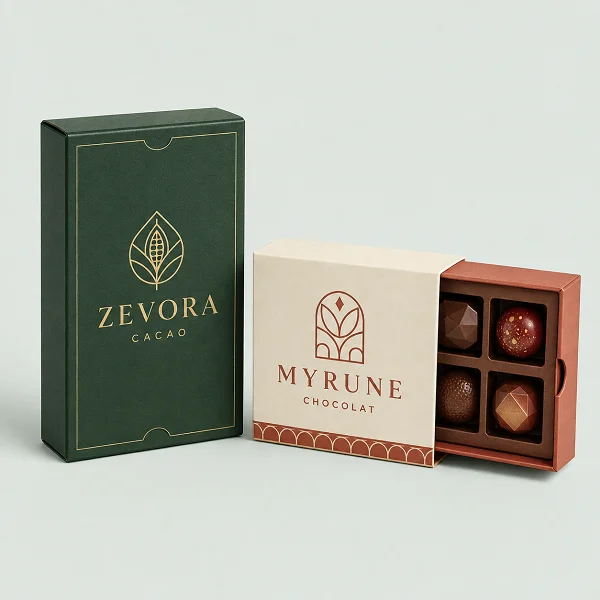
A tray slides into an outer sleeve to create a smooth reveal. This format can work for bars or arranged chocolates when a suitable insert is added. The sleeve provides a large printable surface while the inner tray can use a matching or contrasting colour. A thumb cut can make the tray easier to open.
Two-Piece Lid and Base Boxes
A separate lid lifts away from the base and gives the packaging a familiar gift-box character. This style works particularly well for assorted pieces. It may be made from folding paperboard for an economical result or wrapped rigid board for a more substantial feel.
Window Chocolate Boxes
A die-cut window lets customers see the product or internal arrangement. The opening may be left uncovered when the chocolates are already sealed or fitted with a transparent film where appropriate. Window placement should preserve enough board around the opening to maintain the carton shape.
Rigid Cardboard Chocolate Boxes
Rigid board is often chosen for premium gifting and limited collections. It can support magnetic lids and drawer formats as well as traditional lid-and-base structures. These luxury chocolate boxes cost more to produce and ship than folding cartons. Their substantial construction can suit products positioned at a higher retail value.
Materials for Cardboard Chocolate Packaging
Material selection for chocolate packaging boxes should reflect the size and weight as well as the finish and required level of rigidity. We can recommend a suitable option after reviewing your specifications. A physical sample may be helpful when the fit or product presentation must be checked before a larger production run.
| Material |
Key Features |
Suitable Uses |
Points to Consider |
| Paperboard |
Creates clean folding cartons and supports detailed printing with bright colours. |
Custom cardboard chocolate boxes and individual chocolate bar cartons. |
The board thickness should be selected according to the box dimensions and packed weight. |
| Kraft Board |
Provides a natural brown appearance that works well with simple artwork and darker inks. |
Understated chocolate packaging and ranges with a natural design direction. |
Printed colours can appear different from those produced on white board. Review a proof or sample when colour accuracy matters. |
| Corrugated Cardboard |
Contains a fluted layer that provides additional cushioning and structural strength. |
Larger chocolate sets and ecommerce packs as well as display cartons and outer shipping boxes. |
Fine flutes provide a neater retail appearance while heavier constructions are better suited to transit packaging. |
| Rigid Board |
Maintains a firm shape and can be covered with a printed or coloured wrap for a premium finish. |
Luxury chocolate collections and corporate gifts as well as seasonal presentation boxes. |
Rigid boxes do not fold flat and may require more storage and shipping space. |
Food-Safe Inserts and Protective Compartments
An attractive exterior cannot compensate for chocolates that arrive out of position. Inserts can organise the contents and reduce movement during normal handling. They also create a balanced presentation when the lid opens. The insert design should be based on actual product dimensions rather than an estimated piece count.
Paperboard inserts can be folded to create individual cells or a raised platform. Corrugated inserts may be suitable for heavier items or shipping packs. Other options may be available for specialised projects. Any component intended to touch unwrapped chocolate must be confirmed for that use before production.
Send the maximum width and length as well as the height of each chocolate. Include decorations that extend beyond the main shape. We also need the number of pieces and their preferred layout. For wrapped bars we require the final dimensions after wrapping rather than the size of the bare chocolate.
Turn Cardboard into a Recognisable Brand Asset
Custom cardboard chocolate boxes can carry much more than a logo. The front panel can establish the product name and flavour while the side and back panels provide space for supporting information. The inside lid may carry a short story or serving suggestion where the structure allows interior printing.
CMYK and PMS Printing
CMYK printing is suited to artwork that uses several colours and photographic elements. PMS colour matching may be considered when a particular brand colour is important. The final appearance can vary between white and kraft stock. The selected lamination may also influence how colours are perceived.
Interior and Exterior Artwork
Exterior printing creates shelf impact while interior printing adds interest during opening. A contrasting internal colour can make cardboard chocolate boxes feel more considered. Not every surface needs artwork. Allowing some areas to remain quiet can improve readability and give the main design elements room to stand out.
Information Customers Need
Your artwork may need room for ingredients and allergen declarations as well as net weight and storage directions. Include the barcode and business details where required. Packaging design does not replace the need to check Australian labelling obligations. Your business remains responsible for ensuring the supplied artwork contains the correct information.
Finishing Options for Custom Printed Cardboard Chocolate Boxes
Finishing can change the appearance and feel of custom cardboard chocolate boxes. It should support the design rather than distract from it. The achievable result depends on the board and artwork as well as the box structure.
| Finishing Option |
Appearance and Feel |
Suitable Application |
Points to Consider |
| Matte Lamination |
Reduces shine and creates a restrained surface appearance. |
Premium chocolate ranges and designs with subtle colours. |
Adds some protection against routine rubbing but does not make cardboard waterproof. |
| Gloss Lamination |
Creates a brighter surface and can make printed colours appear more vivid. |
Colourful retail packaging and seasonal chocolate collections. |
May show reflections under strong lighting and does not make the packaging waterproof. |
| Soft-Touch Lamination |
Provides a smooth tactile surface with a premium character. |
Luxury chocolate packaging and corporate gift collections. |
Dark colours may show handling marks. Review a sample before confirming the finish. |
| Foil Stamping |
Adds a metallic or coloured highlight to selected design elements. |
Logos and borders as well as product names and selected wording. |
Very fine details and large solid areas should be reviewed before production. |
| Embossing |
Raises a logo or pattern above the board surface to create depth. |
Logos and lettering on custom printed cardboard chocolate boxes. |
Clear shapes and suitable board stocks generally produce the strongest results. |
| Debossing |
Presses a selected element into the board for a recessed effect. |
Understated branding and tactile design details. |
Extremely intricate artwork may lose clarity when pressed into the material. |
| Spot UV |
Adds a glossy highlight to selected parts of the printed design. |
Logos and patterns or details placed over a matte background. |
Accurate registration is required because the finish must align with specific artwork areas. |
Measure Your Chocolates Before Requesting a Quote
| Measurement Step |
What to Measure or Check |
Why It Matters |
| Prepare the Product |
Measure each chocolate in its final packing condition. Include wrappers and cups as well as tissue or other protective materials. |
This helps establish a practical internal size for custom cardboard chocolate boxes. |
| Arrange the Collection |
Place assorted chocolates in the arrangement you want customers to see and measure the complete layout. |
The final arrangement determines the required box dimensions and insert configuration. |
| Measure the Length |
Measure the longest horizontal side of the product or arranged collection. |
Length forms the first measurement in the length × width × depth format. |
| Measure the Width |
Measure the shorter horizontal side at its widest point. |
Correct width helps prevent side-to-side movement inside the box. |
| Measure the Depth |
Measure the total height after including wrappers and cups as well as inserts and raised decorations. |
Suitable depth prevents the lid from pressing against the chocolates. |
| Identify Dimension Type |
State whether the supplied measurements are internal or external dimensions. |
Internal dimensions describe usable packing space. External dimensions support shelf and shipping planning. |
| Allow Clearance |
Include a small amount of space for easy packing without leaving excessive room. |
Too little clearance can make packing difficult while too much may allow chocolates or inserts to move. |
| Check the Structure |
Review a structural sample when accurate fit and product positioning are important. |
A digital proof checks artwork placement but cannot fully confirm physical fit. |
Common Cardboard Chocolate Box Sizes
The following dimensions are practical starting points for custom cardboard chocolate boxes. The final internal size will depend on the chocolate dimensions and arrangement as well as wrappers and cups or inserts. Measure your products in their final packing condition before confirming production.
| Suggested Internal Size (L × W × D) |
Approximate Capacity |
Suitable Chocolate Products |
Suggested Box Style |
| 50 × 50 × 30 mm |
1 chocolate |
Single truffle or praline and small chocolate favours |
Tuck-end or two-piece box |
| 85 × 45 × 30 mm |
2 chocolates |
Small tasting set or wedding favour and promotional pair |
Sleeve and tray or window box |
| 85 × 85 × 30 mm |
4 chocolates |
Four-piece truffle or praline collection |
Two-piece or window box |
| 125 × 85 × 30 mm |
6 chocolates |
Small assorted chocolate collection |
Tray and sleeve or lid-and-base box |
| 165 × 85 × 30 mm |
8 chocolates |
Single-row assortment and corporate chocolate set |
Sleeve and tray or window box |
| 165 × 125 × 30 mm |
12 chocolates |
Medium assorted chocolate collection |
Two-piece or rigid box |
| 210 × 165 × 35 mm |
20–24 chocolates |
Large gift assortment and seasonal collection |
Rigid or two-piece box with insert |
| 155 × 80 × 20 mm |
1 standard chocolate bar |
Individually wrapped retail chocolate bar |
Tuck-end carton or printed sleeve |
| 200 × 100 × 25 mm |
1 large bar or slim set |
Premium chocolate slab or narrow tasting collection |
Tuck-end carton or tray and sleeve |
| Custom Size |
Made to requirement |
Unusual shapes and mixed collections or specialised inserts |
Structure selected for the product |
Note: Capacities are approximate. Chocolate dimensions can vary between products. Final box measurements should be confirmed with the wrapped chocolates and intended insert before production.
Wholesale Cardboard Chocolate Boxes for Australian Businesses
Our minimum order starts at 100 boxes. This provides a practical entry point for small businesses and new product ranges. Larger quantities are available for established retail lines and recurring campaigns. The unit cost usually decreases as the production quantity increases because setup expenses are spread across more boxes.
Wholesale cardboard chocolate boxes can be produced for launches and corporate gifting as well as festive ranges. Planning early is important when the boxes are needed for Christmas or Easter as well as Valentine’s Day. Time should be allowed for quotation and artwork approval plus production and delivery.
For bulk cardboard chocolate packaging we recommend confirming expected annual volumes and likely order frequency. A consistent structure can be retained while artwork changes between flavours or occasions. This may simplify future planning subject to the printing method and order specifications.
Cardboard Chocolate Boxes Delivered Across Australia
Fine Packaging supplies customisable cardboard chocolate boxes to businesses across Australia for retail and gifting requirements. We work with customers in Sydney and Melbourne as well as Brisbane and Perth plus Adelaide and other regions. Delivery planning will depend on the final carton size and quantity.
Businesses looking for cardboard boxes for chocolate packaging in Sydney can order custom-made solutions without being limited to a standard local range. Custom production allows the box to follow your product dimensions and supplied artwork. Share your postcode when requesting pricing so the delivery requirements can be reviewed with the project.
Orders are checked before dispatch. Flat-packed cartons should be stored in a clean and dry environment away from excessive heat and humidity. Correct storage helps preserve the board and printed finish before the packaging is assembled and filled.
Plan Packaging That Looks as Good as the Chocolates Inside
Move beyond generic packaging with Custom Cardboard Chocolate Boxes created for your product and presentation goals. Tell Fine Packaging your box style and dimensions as well as quantity and artwork requirements. Email support@finepackaging.com.au to request free quotes. We also provide free shipping across Australia so you can plan your packaging costs with greater confidence.