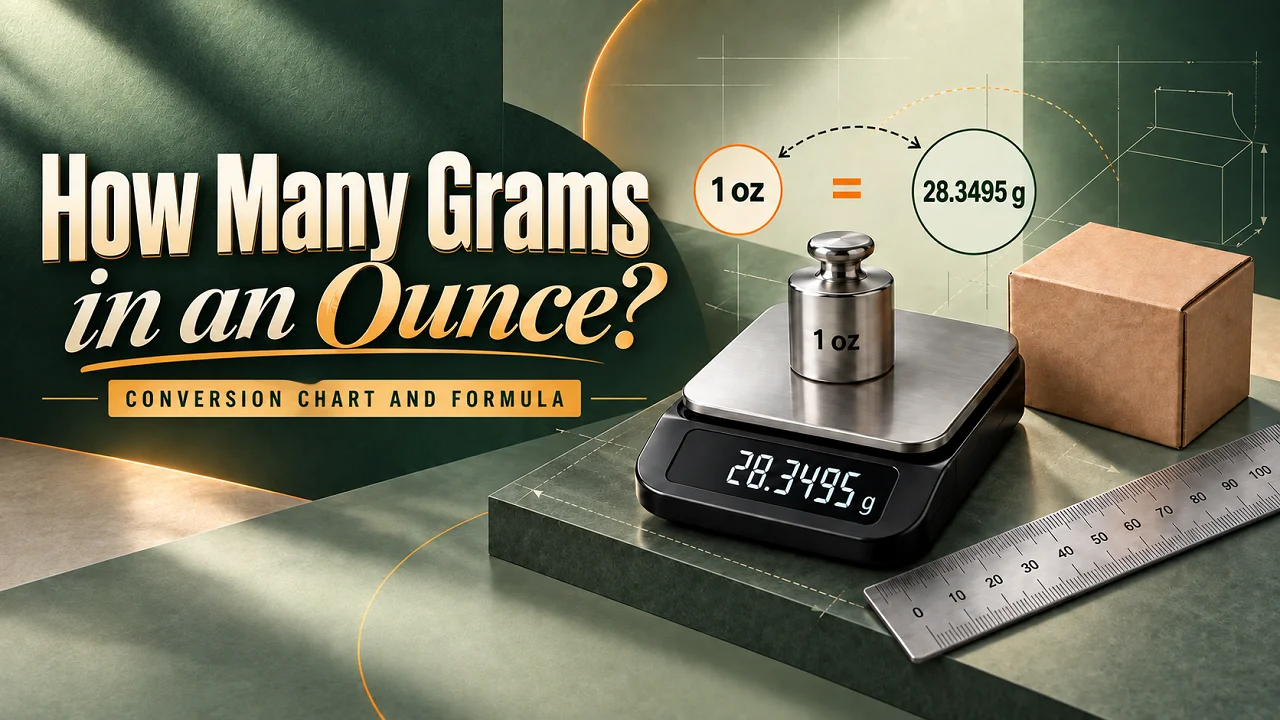
One standard ounce equals 28.3495 grams. For most everyday calculations you can round this to 28.35 grams. This guide explains how to convert grams and ounces through clear formulas useful examples and quick-reference tables. It also shows why product weight matters when planning packaging. You can request a free quote if you need help with custom packaging for your goods.
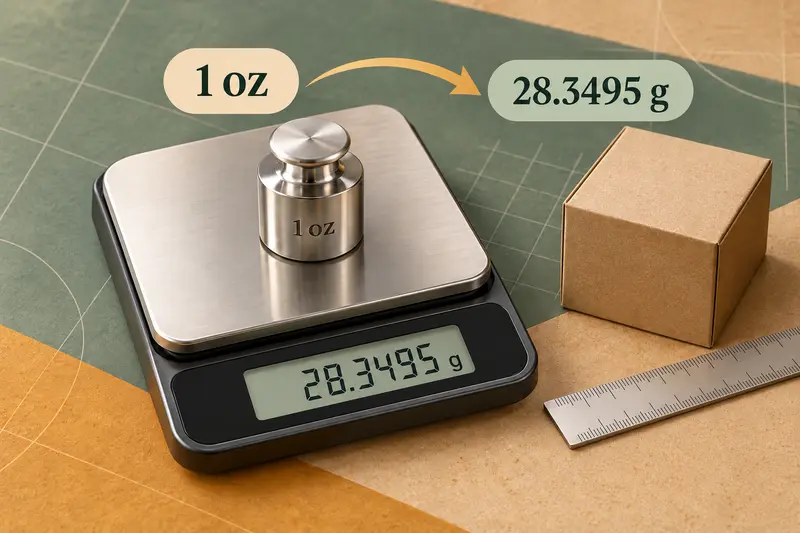
Quick Answer: There are 28.3495 grams in an ounce. Rounded to two decimal places this is 28.35 g. To convert ounces to grams multiply the number of ounces by 28.3495.
How Many Grams Are in an Ounce?
There are exactly 28.349523125 grams in one standard avoirdupois ounce. The shorter figure of 28.3495 grams is accurate enough for packaging specifications and most daily calculations. A rounded figure of 28.35 grams is also suitable when a tiny fraction of a gram will not affect the result.
The avoirdupois ounce is the ordinary weight unit used for products, food and general goods. It is different from a fluid ounce which measures volume. It is also different from a troy ounce which is normally used for precious metals.
If a supplier lists a product at 1 oz you can record its weight as 28.35 g. A product weighing 10 oz is about 283.50 g. The same fixed conversion applies whether the item is coffee, tea, cosmetics, hardware, or another solid product.
What is 1 oz in grams?
The answer to 1 oz in grams is 28.3495 g for a standard ounce. A whole-number estimate is 28 g but 28.35 g is better for packaging records and weight comparisons.
What Are Grams and Ounces?
What is a gram?
A gram is a metric unit of mass. Its symbol is g. Australia uses the metric system so grams and kilograms commonly appear on custom labels and stickers, shipping documents and packaging specifications.
One thousand grams make one kilogram. Grams are useful for lightweight products because they allow a precise figure without relying on a decimal portion of a kilogram. For example a packed item can be listed as 375 g instead of 0.375 kg.
What is an ounce?
An ounce is a unit used in the imperial and US customary systems. Its common abbreviation is oz. Ounces may appear on overseas product details or supplier documents. They are also common on goods made for the United States.
Sixteen ounces make one pound. When an Australian business receives measurements in ounces it may need to convert them into grams before arranging packaging or comparing freight information.
Working with weights listed in pounds? Our pounds to grams conversion chart covers common amounts with a simple formula you can use for your own calculations.
How to Convert Ounces to Grams
Use this formula to convert ounces to grams:
Grams = ounces × 28.3495
Suppose a product weighs 6 ounces:
6 × 28.3495 = 170.097 grams
You can record the result as 170.10 g when two decimal places are needed. You may round it to 170 g when a whole number is suitable. The required level of precision depends on how the figure will be used.
Ounces-to-Grams Weight Conversion Chart
| Ounces |
Grams |
Rounded grams |
| 0.5 oz |
14.1748 g |
14.17 g |
| 1 oz |
28.3495 g |
28.35 g |
| 2 oz |
56.6990 g |
56.70 g |
| 3 oz |
85.0485 g |
85.05 g |
| 4 oz |
113.3980 g |
113.40 g |
| 5 oz |
141.7475 g |
141.75 g |
| 8 oz |
226.7960 g |
226.80 g |
| 10 oz |
283.4950 g |
283.50 g |
| 12 oz |
340.1940 g |
340.19 g |
| 16 oz |
453.5920 g |
453.59 g |
This ounce-to-gram conversion chart uses the standard ounce. Sixteen ounces equal one pound which is about 453.592 grams.
Quick oz to g Calculation
For a quick oz to g calculation multiply the ounce figure by 28.3495. Enter the complete number into your calculator and round only after reaching the final answer.
How to Convert Grams to Ounces
Use the reverse formula when you need to change grams into ounces:
Ounces = grams ÷ 28.3495
A product weighing 250 grams can be converted like this:
250 ÷ 28.3495 = 8.8185 ounces
The converted weight is approximately 8.82 oz. Keep extra decimal places during the calculation. Round only the final result to reduce avoidable differences.
Grams-to-Ounces Conversion Chart
| Grams |
Ounces |
Rounded ounces |
| 10 g |
0.3527 oz |
0.35 oz |
| 25 g |
0.8818 oz |
0.88 oz |
| 50 g |
1.7637 oz |
1.76 oz |
| 100 g |
3.5274 oz |
3.53 oz |
| 150 g |
5.2911 oz |
5.29 oz |
| 200 g |
7.0548 oz |
7.05 oz |
| 250 g |
8.8185 oz |
8.82 oz |
| 500 g |
17.6370 oz |
17.64 oz |
| 750 g |
26.4555 oz |
26.46 oz |
| 1,000 g |
35.2740 oz |
35.27 oz |
Why Grams and Ounces Matter in Packaging
Weight can influence the box structure protective materials and shipping method. A light retail carton has different requirements from a box carrying a dense metal part. An accurate weight also helps a packaging supplier understand how much load the base and closures may need to support.
Australian businesses may receive product data from an overseas manufacturer in ounces. Their local packaging details may use grams or kilograms. Converting everything into one system makes comparisons easier and reduces the chance of entering the wrong figure on a brief.
Fine Packaging may ask for the product weight and the expected packed weight when assessing a custom box. These figures provide useful context but weight alone does not determine the right construction. Product dimensions fragility storage conditions and the way boxes will be transported also need attention.
Net Weight and Gross Weight Are Not the Same
Net weight is the weight of the product without its packaging. Gross weight includes the product and all packaging components. Those components may include the box, insert, custom tissue paper, wrap, label, and protective fill.
A product might have a net weight of 250 g while its complete packed weight is 315 g. Use the packed figure when a courier or freight calculation asks for the total physical weight. Use the net figure where a product declaration specifically requires the contents alone.
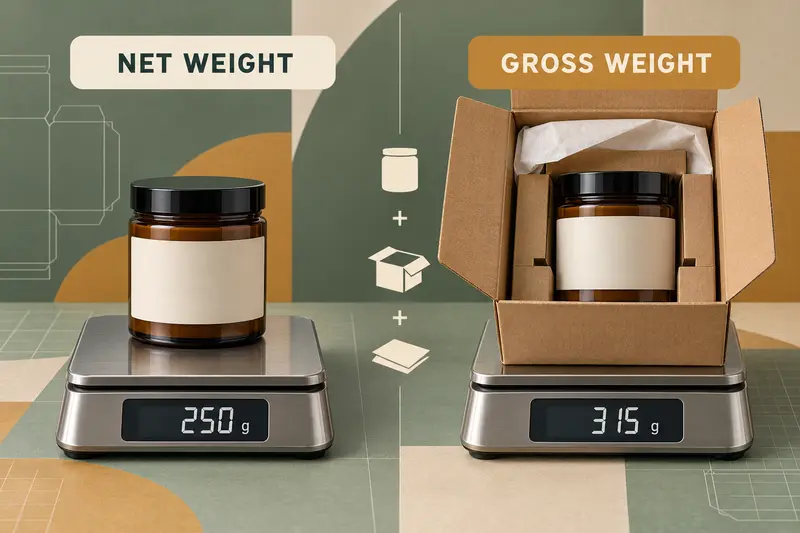
Expert Tip: Weigh the final packed arrangement rather than estimating the packaging weight. Include the insert and every item that will travel with the product. This gives you a more useful figure for freight planning and packaging tests.
Standard Ounces and Troy Ounces
The answer to how many grams in an ounce changes when the term refers to a troy ounce. A standard avoirdupois ounce equals 28.3495 g. A troy ounce equals about 31.1035 g.
| Ounce type |
Equivalent in grams |
Common use |
| Avoirdupois ounce |
28.3495 g |
General products and everyday goods |
| Troy ounce |
31.1035 g |
Gold silver and other precious metals |
Use the standard ounce unless the source clearly states that the weight is in troy ounces. If you package jewellery it is worth checking which ounce has been used before recording the product weight.
Weight Ounces and Fluid Ounces
A weight ounce and a fluid ounce measure different things. An ounce written as oz usually refers to weight. A fluid ounce written as fl oz measures volume. You cannot reliably convert fluid ounces to grams without knowing the density of the substance.
For example one fluid ounce of water does not have the same mass as one fluid ounce of a thick oil. Their volumes may match but their weights can differ. There is another complication because an imperial fluid ounce and a US fluid ounce are not the same volume.
Check whether the original figure describes mass or volume before using an ounce-to-gram conversion. Ask the supplier when the unit is unclear. A guess could affect a product label or a packaging brief.
How to Weigh a Product for Packaging
- Use a suitable digital scale. Check that its capacity can handle the complete packed item and that its increments provide enough detail.
- Place an empty container on the scale. Use the tare function to return the display to zero before adding the product.
- Weigh the unpacked product. Record this as the net weight if that term applies to your item.
- Pack the product as it will be supplied. Add the box insert wrap labels instructions and any accessories.
- Weigh the complete pack. Record the result as the gross or packed weight.
- Repeat the check. Test more than one unit if product weights vary across a batch.
Record both the number and its unit. Writing only "250" can cause confusion. Write "250 g" or "8.82 oz" so anyone reading the specification knows which system applies.
Choosing the Right Level of Rounding
A calculator may show many digits after the decimal point. That does not mean every digit is useful. Two decimal places are generally clear for a conversion guide. A whole gram may be enough for an early packaging discussion.
More precision may be needed for regulated declarations laboratory work or very small products. Follow the rules that apply to your product and market. Fine Packaging can help with box construction and printed presentation but the business supplying the goods remains responsible for confirming its required label information.
Avoid repeatedly rounding a figure as it moves between units. Keep the full conversion value during your calculation. Round the result once at the end.
Common Conversion Mistakes
Using 28 grams as an Exact Answer
One ounce is often described as 28 grams because that number is easy to remember. It is only a rounded estimate. Use 28.3495 g when you need a more accurate calculation.
Confusing an Ounce With a Fluid Ounce
Ordinary ounces measure mass while fluid ounces measure volume. A direct fluid-ounce-to-gram answer needs the density of the substance and the type of fluid ounce.
Using a Troy ounce for an Everyday Product
Troy ounces are intended for precious metals. Most consumer goods use the standard avoirdupois ounce.
Leaving the Packaging out of the Packed Weight
Couriers and packaging suppliers may need the full packed weight rather than the product weight alone. Weigh all components together when that is the figure being requested.
Use Weight Conversions in Your Packaging Brief
A clear packaging brief should include the product dimensions and weight. It should also explain how the item will sit inside the box. Add the packed weight when it is available. If the original details use ounces you can provide both units such as 8 oz or 226.80 g.
Weight is only one part of a complete specification. Our packaging measurement and weight conversion guide explains other common units and shows how to record product dimensions for custom packaging.
If you are planning custom boxes, Fine Packaging can review the size product weight and intended use before preparing a free quote. We can also discuss suitable materials printing and inserts for your product. Email support@finepackaging.com.au to share your requirements. Free shipping is available Australia-wide.
Frequently Asked Questions
How many grams are in one ounce?
One standard avoirdupois ounce equals 28.3495 grams. It is commonly rounded to 28.35 grams.
Is one ounce exactly 28 grams?
No. One standard ounce is slightly more than 28 grams. The precise conversion is 28.349523125 grams.
How do I convert ounces to grams?
Multiply the number of ounces by 28.3495. For example 5 oz multiplied by 28.3495 equals 141.7475 g.
How do I convert grams to ounces?
Divide the number of grams by 28.3495. For example 100 g divided by 28.3495 equals approximately 3.53 oz.
How many grams are in 8 ounces?
Eight standard ounces equal 226.796 grams. This can be rounded to 226.80 g or 227 g depending on the required precision.
Are fluid ounces the same as ounces?
No. An ounce measures mass while a fluid ounce measures volume. Converting fluid ounces to grams requires the density of the substance.